On this site you can find a sermon for just about each Sunday of the Common Lectionary via the search box.
Updated 5 May 2023
Coronation Thoughts (The day after Charles III was crowned)
Fifth Sunday of Easter (A)
Acts 7.55-60; 1 Peter 2.2-10; John 14.1-14
I went out for a walk along a lovely leafy Cheshire byway earlier in the week. It’s a favourite spot of mine – a quiet winding country lane, lots of wildflowers and birds, ancient hedges, and vistas across well-kept fields. Just lovely! And there it was. A heap of broken stones, builders waste and rubble, spilling across the grassy verge and onto the road. The scourge of fly-tipping.
I stared disconsolate at the awkward shaped sandstone lumps in that dreadful pile. My mind immediately went to another lump of sandstone. Not much different really – age scarred, roughly hewn, and pot-marked – a lump of sandstone. But this stone was greeted with great ceremony, well-guarded, and carefully installed in Westminster Abbey just last week. It was, of course, the Stone of Scone/The Stone of Destiny on which the king was crowned yesterday – as for many centuries those before him were also crowned.
Despoiled grassy verge and coronation throne – two lumps of sandstone. A mess or a regal symbol; worthless and discarded or a prized national treasure; an unsightly problem or a revered signifier; good for nothing or meaning beyond value? Such is the ambiguity of stone.
And it’s there in our readings. The crowd drags Stephen out of the city – out of the place of dressed and carefully built stones to the waste land of dust and boulders. To press home the point, Luke says that Stephen’s words about the Temple – those carefully built stones – and how they had confined God to that stone edifice rather than responding to the prophets’ calls for a just living that embraced the whole of life – it was those words that finally made them turn on Stephen and chase him out from amongst the buildings to the waste land – and there they grab the stones that lay about the place and hurled them at Stephen’s head. He’s probably in a pit, unable to run from their throws. The stones rain down on him. Stones of death.
But we are to be stones of life, says 1 Peter. Be like ‘living stones’ built into a spiritual house – steadfast, well-fitted, leaning on each other, strong and long-lasting, a people united together. In solidarity because the corner stone that holds us together is Christ himself. Living stones – stones of life.
Christ is made the sure Foundation,
Christ the head and Corner-stone,
Chosen of the Lord, and precious,
Binding all the Church in one,
Holy Sion’s help for ever,
And her confidence alone.
‘Let yourselves be built,’ says 1 Peter, by ‘the spiritual sacrifices acceptable to God through Jesus Christ.’ In other words, it is Christ who shapes and places these living stones. I was brought up in the Cotswolds. Here the fields have often been given their shape and size by dry stone walls made from the local Cotswold sandstone. Many of these walls are hundreds of years old. As a youngster I was deeply impressed by the work of the Dry-Stone Wallers creating such mortar-less walls. With only the simplest of tools – a chipping hammer, a string line, and perhaps a shovel – the dry-stone waller builds a strong boundary wall of elegance and durability that will serve its purpose for many generations. On completion there is nothing remaining behind the waller as debris and chippings will have been incorporated into the centre of the wall. There is simply no mess and nothing ‘left-over.’ The strength, resilience and serviceability of the wall are achieved by the artful skill of the waller. Such a waller is Christ – nothing is wasted, nothing goes for nothing of the living stones he uses.
The ambiguity of stones – stones of death, stones of life. I suppose all great symbols have a similar ambiguity – Kingship certainly does. The Stone of Scone is a good signifier of that: we don’t need Scottish nationalists to remind us that Edward I seized the stone during his invasion of Scotland in 1296 – as well as continuity, durability and heritage, that stone is a reminder of enmity, war, and unfinished business. It speaks of the ambiguities of Kingship – its challenges as well as its nobility, its responsibility as well as its power, its realities as well as its romance. We pray for the King – as well we should, remembering that the weight of all those things is focussed on just one person.
On the occasion of her 21st birthday in 1947, the late Queen famously said, ‘I declare before you all that my whole life whether it be long or short shall be devoted to your service.’ Churchill is said to have cried on hearing those words – whether that is true or not – we all know the power of those words because we came across her long reign to know that she believed them – she possessed them, she made them her own.
I take heart in the fact that the King has described his own aspirations in rather more down-to-earth categories, as befits our contemporary outlook. Down-to-earth, yes, but noble still – in the best sense of the word:
‘I find myself born into this particular position. I’m determined to make the most of it. And to do whatever I can to help. And I hope I leave things behind a little better than I found them!’
And again, ‘I believe passionately that everyone has a particular God-given ability.’
A determination to strive for the best in the particularity of circumstances, a concern that is passionate about issues, and an urge to change things for the better and recognise everyone’s abilities. We pray for the King as he makes such aspirations his own. Whatever else kingship is about in our contemporary era, it must be about being united together around this focal person, so that we ourselves are incorporated in those aspirations.
And that brings me back to stones. Stones make edifices – like that great Temple Stephen spoke about and incurred the deathly anger of the crowd. Stones make edifices – huge structures that impose and dominate. Indeed, perhaps their very purpose is to make you feel small and insignificant. In their towering structure they are attractive but troubling too. Impressive and complex but dominating. Isn’t that why we go to look at them?
Stonehenge has standing bluestones four metres high topped with huge lintels. Each one weighs 25 tons and was brought 150 miles from south Wales something like 4500 years ago. Why? And how was it possible. We stand next to the huge stones and wonder.
Is kingship like that? A huge symbolic edifice that no one really understands completely. In some sense, perhaps? The King has spoken himself about the lack of a set role but has also spoken of his urge to do the right thing. Intuition and imagination seem to be key to that – we’re back to his majesty’s aspiration to make the most of it. And passion, response to circumstance, the urge to positive change, intuition and imagination are all things of the person not the edifice, the humane not the institutional, - the lively not the stoney, if you like.
And that’s how we must read Christ’s words about his Father’s house in the gospel reading. Don’t read it as Stephen said his contemporaries did, where the grandeur of huge building blocks obscured the reality of God and reduced faithfulness to a self-serving edifice that put splendour and show above the realities of everyday and God’s justice.
After the resurrection, John tells us, the disciples realised when Jesus spoke of the Temple he was talking about the temple of his body. Christ it is who is the living stone, and we are to be like him. My Father’s house is wherever Jesus dwells.
Later in the chapter (v23) Jesus will say, ‘Those who love me will keep my word, and my Father will love them, and we will come to them and make our home with them.’ This divine home – built of living stones founded on the living stone – the home of Jesus and his Father, is simply every place of mutual love. This is the place chosen and precious – not some great edifice or institution, but those ordinary places where spiritual sacrifices emulate Christ’s own sacrifice are made plain: death refusing hope; division annulled by unity; love triumphant.
This is the house built of living stones. This is our home. This is where we belong.
To this temple, where we call thee,
Come, O Lord of Hosts, today;
With thy wonted loving kindness
Hear thy servants as they pray,
And thy fullest benediction
Shed within its walls alway.
Fifth Sunday of Easter (A)
Acts 7.55-60; 1 Peter 2.2-10; John 14.1-14
I went out for a walk along a lovely leafy Cheshire byway earlier in the week. It’s a favourite spot of mine – a quiet winding country lane, lots of wildflowers and birds, ancient hedges, and vistas across well-kept fields. Just lovely! And there it was. A heap of broken stones, builders waste and rubble, spilling across the grassy verge and onto the road. The scourge of fly-tipping.
I stared disconsolate at the awkward shaped sandstone lumps in that dreadful pile. My mind immediately went to another lump of sandstone. Not much different really – age scarred, roughly hewn, and pot-marked – a lump of sandstone. But this stone was greeted with great ceremony, well-guarded, and carefully installed in Westminster Abbey just last week. It was, of course, the Stone of Scone/The Stone of Destiny on which the king was crowned yesterday – as for many centuries those before him were also crowned.
Despoiled grassy verge and coronation throne – two lumps of sandstone. A mess or a regal symbol; worthless and discarded or a prized national treasure; an unsightly problem or a revered signifier; good for nothing or meaning beyond value? Such is the ambiguity of stone.
And it’s there in our readings. The crowd drags Stephen out of the city – out of the place of dressed and carefully built stones to the waste land of dust and boulders. To press home the point, Luke says that Stephen’s words about the Temple – those carefully built stones – and how they had confined God to that stone edifice rather than responding to the prophets’ calls for a just living that embraced the whole of life – it was those words that finally made them turn on Stephen and chase him out from amongst the buildings to the waste land – and there they grab the stones that lay about the place and hurled them at Stephen’s head. He’s probably in a pit, unable to run from their throws. The stones rain down on him. Stones of death.
But we are to be stones of life, says 1 Peter. Be like ‘living stones’ built into a spiritual house – steadfast, well-fitted, leaning on each other, strong and long-lasting, a people united together. In solidarity because the corner stone that holds us together is Christ himself. Living stones – stones of life.
Christ is made the sure Foundation,
Christ the head and Corner-stone,
Chosen of the Lord, and precious,
Binding all the Church in one,
Holy Sion’s help for ever,
And her confidence alone.
‘Let yourselves be built,’ says 1 Peter, by ‘the spiritual sacrifices acceptable to God through Jesus Christ.’ In other words, it is Christ who shapes and places these living stones. I was brought up in the Cotswolds. Here the fields have often been given their shape and size by dry stone walls made from the local Cotswold sandstone. Many of these walls are hundreds of years old. As a youngster I was deeply impressed by the work of the Dry-Stone Wallers creating such mortar-less walls. With only the simplest of tools – a chipping hammer, a string line, and perhaps a shovel – the dry-stone waller builds a strong boundary wall of elegance and durability that will serve its purpose for many generations. On completion there is nothing remaining behind the waller as debris and chippings will have been incorporated into the centre of the wall. There is simply no mess and nothing ‘left-over.’ The strength, resilience and serviceability of the wall are achieved by the artful skill of the waller. Such a waller is Christ – nothing is wasted, nothing goes for nothing of the living stones he uses.
The ambiguity of stones – stones of death, stones of life. I suppose all great symbols have a similar ambiguity – Kingship certainly does. The Stone of Scone is a good signifier of that: we don’t need Scottish nationalists to remind us that Edward I seized the stone during his invasion of Scotland in 1296 – as well as continuity, durability and heritage, that stone is a reminder of enmity, war, and unfinished business. It speaks of the ambiguities of Kingship – its challenges as well as its nobility, its responsibility as well as its power, its realities as well as its romance. We pray for the King – as well we should, remembering that the weight of all those things is focussed on just one person.
On the occasion of her 21st birthday in 1947, the late Queen famously said, ‘I declare before you all that my whole life whether it be long or short shall be devoted to your service.’ Churchill is said to have cried on hearing those words – whether that is true or not – we all know the power of those words because we came across her long reign to know that she believed them – she possessed them, she made them her own.
I take heart in the fact that the King has described his own aspirations in rather more down-to-earth categories, as befits our contemporary outlook. Down-to-earth, yes, but noble still – in the best sense of the word:
‘I find myself born into this particular position. I’m determined to make the most of it. And to do whatever I can to help. And I hope I leave things behind a little better than I found them!’
And again, ‘I believe passionately that everyone has a particular God-given ability.’
A determination to strive for the best in the particularity of circumstances, a concern that is passionate about issues, and an urge to change things for the better and recognise everyone’s abilities. We pray for the King as he makes such aspirations his own. Whatever else kingship is about in our contemporary era, it must be about being united together around this focal person, so that we ourselves are incorporated in those aspirations.
And that brings me back to stones. Stones make edifices – like that great Temple Stephen spoke about and incurred the deathly anger of the crowd. Stones make edifices – huge structures that impose and dominate. Indeed, perhaps their very purpose is to make you feel small and insignificant. In their towering structure they are attractive but troubling too. Impressive and complex but dominating. Isn’t that why we go to look at them?
Stonehenge has standing bluestones four metres high topped with huge lintels. Each one weighs 25 tons and was brought 150 miles from south Wales something like 4500 years ago. Why? And how was it possible. We stand next to the huge stones and wonder.
Is kingship like that? A huge symbolic edifice that no one really understands completely. In some sense, perhaps? The King has spoken himself about the lack of a set role but has also spoken of his urge to do the right thing. Intuition and imagination seem to be key to that – we’re back to his majesty’s aspiration to make the most of it. And passion, response to circumstance, the urge to positive change, intuition and imagination are all things of the person not the edifice, the humane not the institutional, - the lively not the stoney, if you like.
And that’s how we must read Christ’s words about his Father’s house in the gospel reading. Don’t read it as Stephen said his contemporaries did, where the grandeur of huge building blocks obscured the reality of God and reduced faithfulness to a self-serving edifice that put splendour and show above the realities of everyday and God’s justice.
After the resurrection, John tells us, the disciples realised when Jesus spoke of the Temple he was talking about the temple of his body. Christ it is who is the living stone, and we are to be like him. My Father’s house is wherever Jesus dwells.
Later in the chapter (v23) Jesus will say, ‘Those who love me will keep my word, and my Father will love them, and we will come to them and make our home with them.’ This divine home – built of living stones founded on the living stone – the home of Jesus and his Father, is simply every place of mutual love. This is the place chosen and precious – not some great edifice or institution, but those ordinary places where spiritual sacrifices emulate Christ’s own sacrifice are made plain: death refusing hope; division annulled by unity; love triumphant.
This is the house built of living stones. This is our home. This is where we belong.
To this temple, where we call thee,
Come, O Lord of Hosts, today;
With thy wonted loving kindness
Hear thy servants as they pray,
And thy fullest benediction
Shed within its walls alway.
PreacherRhetorica -
dedicated to preaching that's alert to the contemporary,
passionate about Christian memory, and works to be heard.
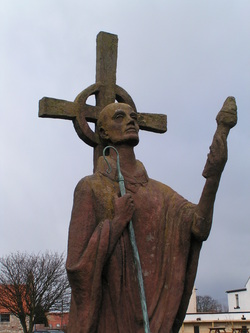 Saint Aidan - Holy Island of Lindisfarne
In a social environment where discordance is all too apparent the preacher struggles to be heard as a voice of eternal verities. So much conspires towards a forgetfulness of the memory from which that voice speaks, and to which that voice gives enabling testimony. Yet the preacher still speaks: turning this way and that, between text, memory and world; striving, in a largely amnesic society to create something out of whatever materials come to
hand; trying to shape in words that generative drive that is tradition’s gift; and exemplifying in that trying what is the calling of every believer—to live in the memory of Christ.
In the words of Augustine, the preacher prays:
[Lord,] you have honoured my memory by making it your dwelling-place.
Augustine, Confessions, 10.25
The sermons on the pages that follow attempt to address both that forgetfulness and
that remembrance.
hand; trying to shape in words that generative drive that is tradition’s gift; and exemplifying in that trying what is the calling of every believer—to live in the memory of Christ.
In the words of Augustine, the preacher prays:
[Lord,] you have honoured my memory by making it your dwelling-place.
Augustine, Confessions, 10.25
The sermons on the pages that follow attempt to address both that forgetfulness and
that remembrance.
Preaching as memory work
Every Christian gathering is a mnemonic event. Christians gather to remember that they are remembered by God. This is an actual re-membering: a way of putting together again the Body of Christ in order that it may be dispersed into the world when the gathering is over. In the coming together each individual's faith memory is renewed as it is reincorporated into the collective memory of
the people of faith. We remember by communicating with one another, and that remembering enables us to live out the faith. Without that social remembering
our individual memories fade.
We live in forgetful times which make it ever harder for an inherited faith to be heard. This website is dedicated to the ways preaching can help overcome our contemporary cultural faith amnesia. It is offered in thankfulness for the many who have prompted and reinforced Christian memory by what they have said or written.
Preaching is always a communal effort that is dependent on what has been said before – not least, of course, in the Scriptures themselves. Any originality in these pages is little more than a combination of ideas in an unfamiliar pattern. For that continuing pattern-making you are free to use anything you find useful here in assisting your own Christian memory work or that of a congregation of which you are a part. An acknowledgement of PreacherRhetorica would be great if possible. Notice of errors, omissions, or oversights in these pages would be appreciated. Please use the form above.
Every Christian gathering is a mnemonic event. Christians gather to remember that they are remembered by God. This is an actual re-membering: a way of putting together again the Body of Christ in order that it may be dispersed into the world when the gathering is over. In the coming together each individual's faith memory is renewed as it is reincorporated into the collective memory of
the people of faith. We remember by communicating with one another, and that remembering enables us to live out the faith. Without that social remembering
our individual memories fade.
We live in forgetful times which make it ever harder for an inherited faith to be heard. This website is dedicated to the ways preaching can help overcome our contemporary cultural faith amnesia. It is offered in thankfulness for the many who have prompted and reinforced Christian memory by what they have said or written.
Preaching is always a communal effort that is dependent on what has been said before – not least, of course, in the Scriptures themselves. Any originality in these pages is little more than a combination of ideas in an unfamiliar pattern. For that continuing pattern-making you are free to use anything you find useful here in assisting your own Christian memory work or that of a congregation of which you are a part. An acknowledgement of PreacherRhetorica would be great if possible. Notice of errors, omissions, or oversights in these pages would be appreciated. Please use the form above.
Click here to see the reasoning behind using a story as a sermon - sometimes.
Preaching in an amnesic society.
Practicalities of design and delivery here.
What is preaching? An attempt at a definition here.
Designing a sermon
What sermon styles and structures serve the maintenance of Christian collective memory best? Often the answer to that question will be 'any that are effective generally.' Unfortunately it's all too easy to preach without giving enough thought to the basics of what's effective. Paying attention to things that serve
the collective memory of the faith can be a way into overcoming that oversight. Sometimes the design of a sermon confuses what is otherwise pertinent and useful
content.
Occasionally in these pages a sermon will be analysed
so as to demonstrate what decisions were taken about style and structure, and the reasoning behind the choices made. You can find the first such analysis of a
sermon for Pentecost here or you can find the sermon script without commentary here.
Updated 5 May 2023.
What sermon styles and structures serve the maintenance of Christian collective memory best? Often the answer to that question will be 'any that are effective generally.' Unfortunately it's all too easy to preach without giving enough thought to the basics of what's effective. Paying attention to things that serve
the collective memory of the faith can be a way into overcoming that oversight. Sometimes the design of a sermon confuses what is otherwise pertinent and useful
content.
Occasionally in these pages a sermon will be analysed
so as to demonstrate what decisions were taken about style and structure, and the reasoning behind the choices made. You can find the first such analysis of a
sermon for Pentecost here or you can find the sermon script without commentary here.
Updated 5 May 2023.
